Wednesday, January 30, 2013

Glatfelter Company Donates Trees to Virginia

York Pennsylvania-based P.H. Glatfelter Company will donate more than 100,000 pine seedlings to Virginia landowners under a seedling match cost-share program. Since 1956, the company has partnered with the Virginia Department of Forestry (VDOF) to provide seedlings for reforestation projects.

VDOF Assistant Director for Forest Management Todd Groh said, “Glatfelter has a long-standing relationship with Virginia landowners. By funding this cost-share program, Glatfelter helps landowners reduce their cost for seedlings by providing up to 10,000 seedlings per landowner for reforestation projects. They are truly a partner in both promoting healthy forests and sustaining the forest resource.”

James Kuykendall, Glatfelter's Southern MD/VA district manager said, “Glatfelter is proud to be able to provide trees in partnership with the Virginia Department of Forestry. This cost-share program allows us to support landowners who recognize the value of the forest resource, as we do. Together we have the opportunity to support healthy forests, healthy communities and responsible industry.”

Under the terms of the program, reforestation projects by private non-industrial woodland landowners are eligible in Amherst, Buckingham, Caroline, Clarke, Culpeper, Cumberland, Fairfax, Fauquier, Fluvanna, Frederick, Greene, King George, Loudoun, Louisa, Madison, Nelson, Orange, Page, Prince William, Rappahannock, Rockingham, Shenandoah, Spotsylvania, Stafford and Warren counties in Virginia.

If you're a landowner interested in participating in this program and have property located in the above counties, please contact your local Virginia Department of Forestry Office for more information.

In 2011, this cost-share program provided 166,000 pine seedlings to Virginians. Glatfelter owns and manages 10,000 acres of forestland in Virginia. Pulpwood from Virginia supplies the company's mill in Spring Grove, Pennsylvania.


Thursday, September 27, 2012

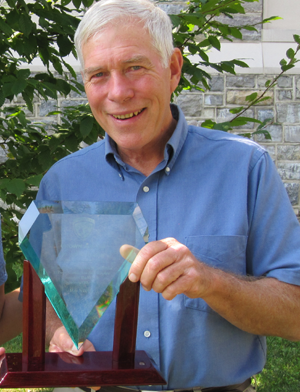
Crown Award Bestowed Upon Virginia Tech Professor Emeritus


Dr. Jeffrey Kirwan, professor emeritus at Virginia Tech and resident of Blacksburg, has been awarded the Virginia Department of Forestry’s highest civilian honor – the Crown Award.Dr. Jeffrey Kirwan, professor emeritus at Virginia Tech and resident of Blacksburg, has been awarded the Virginia Department of Forestry’s highest civilian honor – the Crown Award. The award was presented by VDOF’s Lisa Deaton at a meeting of the faculty of Virginia Tech’s College of Natural Resources.

VDOF established the Crown Award to recognize an individual or entity that has not only gone beyond the call of duty but has set a standard of excellence others can only admire. It is the highest honor the State Forester of Virginia can bestow, and Kirwan is only the fourth recipient of this award.

State Forester Carl Garrison said, “Jeff is no stranger to high praise for significant achievement. He has a sustained and long-term track record of success, and I’m proud to add to his legacy of excellence and unparalleled achievement.”

Kirwan pioneered the use of information technology to involve citizens of all ages in the care and appreciation of trees. He led a natural resources and environmental education program that reached more than 360,000 young people during a 12-year period. And he incorporated service learning into Virginia Tech courses long before the practice became commonplace.

“In addition to being an excellent teacher, Jeff served the public with distinction as a 4-H agent in Loudoun and Albemarle counties,” Garrison said. “We are proud to be able to recognize and thank Jeff for all he has done in service to the citizens of the Commonwealth.”

Thursday, September 6, 2012

2300-Acre Conservation Easement Established in Isle of Wight County


VDOF, DCR and TNC Partner to Conserve Forestland and Protect Water Resource

Isle of Wight County has created a conservation easement on 2,348 acres of forestland that fronts the Blackwater River. This will conserve a large block of forestland, protect a vital source of drinking water for residents in South Hampton Roads and enhance the public’s recreational activities in the county.

The Virginia Department of Forestry, the Virginia Department of Conservation and Recreation and The Nature Conservancy worked together to make this conservation easement a reality. Funds to secure the easement were provided by the USDA Forest Service Forest Legacy Program and by TNC through a grant from the Virginia Land Conservation Fund.

The easement will be jointly held by VDOF and DCR. Approximately 1/3 of the property will become the Blackwater Sandhills Natural Area Preserve – DCR’s 61st such preserve in Virginia – and will include 500 acres of Tupelo-Gum-Baldcypress bottomland that helps protect more than five miles of the Blackwater River. This river is an important source of drinking water for residents of Norfolk. The other 2/3 of the forested property will be the responsibility of the VDOF, which will oversee the management of the resource for timber, wildlife and recreational use. The entire tract will remain the property of Isle of Wight County.

“Isle of Wight County is honored and very pleased to have other agencies join us in our efforts to preserve and maintain such unique natural resources,” said Al Casteen, chairman of the IOW Board of Supervisors. “We in a rural county are particularly aware that we in the present have an obligation to those in the future to be responsible stewards of our natural beauty and bounty. We greatly appreciate the work and help from all concerned to make that goal a reality for this particular property.”

State Forester of Virginia Carl Garrison said, “This easement will forever protect from development a key forested property that fronts a critical source of clean water while increasing recreational opportunities and enhancing wildlife habitat in the area. It’s a big win for residents of Isle of Wight County and all the citizens of the Commonwealth.”

Michael Lipford, executive director for The Nature Conservancy in Virginia, said, “The property’s old-growth cypress forest offers a rare and inspiring glimpse of the majestic forests that once graced Virginia’s coastal region. Thanks to the state and Isle of Wight County, this treasured link to our past will be preserved for future generations to enjoy and will contribute to conservation of the Blackwater River’s water quality, flood storage and wildlife values.”

DCR Director David A. Johnson said, “DCR is proud that a portion of this property will be dedicated as the state’s 61st natural area preserve. With the addition of Blackwater Sandhills, the state’s natural area preserve system now totals 51,394 acres. In addition to protecting old-growth forest, we are preserving sandhills habitat that is suitable for re-establishment of native longleaf pine.”

Including this conservation easement, VDOF’s total easement holdings stand at 22,972 acres conserved – more than half of which (13,660 acres) have been protected during the McDonnell administration.

Thursday, August 2, 2012

Virginia Expands Emerald Ash Borer Quarantine to Include Entire Commonwealth

The Virginia Department of Agriculture and Consumer Services (VDACS) has expanded the Emerald Ash Borer (EAB) Quarantine to include the entire Commonwealth of Virginia. This action became necessary after the recent detection of EAB in the counties of Buchanan, Caroline, Giles, Hanover, Lee, Prince Edward, Stafford and Warren. The quarantine previously included Arlington, Charlotte, Clarke, Fairfax, Fauquier, Frederick, Halifax, Loudoun, Lunenburg, Mecklenburg, Pittsylvania and Prince William counties and the cities of Alexandria, Danville, Fairfax, Falls Church, Manassas, Manassas Park and Winchester.

Under this statewide quarantine, the regulated articles, which include ash trees, green (non-heat treated) ash lumber and ash wood products, as well as hardwood firewood, are no longer subject to localized movement restrictions and may now move freely within the state.

For additional information about the Emerald Ash Borer Quarantine call VDACS at 804.786.3515.

Tuesday, July 17, 2012

Emerald Ash Borer Puts 187 Million Ash Trees In Commonwealth At Risk

The emerald ash borer (EAB), Agrilus planipennis, is a non-native, invasive, wood-boring beetle from Asia that was first detected in Detroit in 2002 and has now spread to 15 states, including Virginia. First found in Fairfax County in 2003, it has been recently confirmed in the counties of Pittsylvania, Halifax, Charlotte, Mecklenburg, Lee, Buchanan, Hanover, Warren, Caroline, Prince Edward, Giles, Loudoun and Stafford. Previous finds include the counties of Arlington, Prince William and Frederick.

VDOF Forest Health Specialist Dr. Chris Asaro said, “EAB is capable of killing all 187 million native ash trees in Virginia, regardless of their initial health and condition. In addition to the ecological problems this will cause, it will have a significant economic impact on the Commonwealth.”

For the last four years, the Department of Forestry has partnered with several other Virginia state agencies, private businesses and the federal government to slow the spread of the EAB through a “Don’t Move Firewood” campaign. Unfortunately – and in spite of state-mandated quarantines in several counties – citizens and visitors to the Commonwealth continue to carry firewood from infested areas to non-infested areas thereby delivering the shiny green and highly destructive beetles to new stands of ash trees, which they can kill in just three years.

Dr. Asaro said, “Despite our collective best efforts to slow down the emerald ash borer, the evidence is quite clear that people are inadvertently moving EAB tens or hundreds of miles in one shot via untreated firewood (which may include ash) and other ash wood products. We know this because, on average, adult borers fly no more than a mile or two, if that, on their own each year.”

While reluctant to make any predictions, the VDOF entomologist said, “My guess for the next decade is that EAB will permeate much of the eastern United States from Maine to Minnesota to Texas and Florida. And based on what little I have seen so far, it’s easy for me to imagine emerald ash borer rendering ash trees in Virginia ecologically and economically extinct within a few decades from now. This would put EAB on par with chestnut blight in terms of the speed and efficiency with which American chestnut was effectively eliminated from the Virginia landscape.”

According to the U.S. Forest Service Forest Inventory and Analysis (FIA) plot data, ash in Virginia represents approximately 1.8 percent of total forested volume statewide – that’s 187 million trees. The vast majority of this volume is made up of two species – white ash (Fraxinus americana) and green ash (Fraxinus pennsylvanica) – with several other minor species in the mix (Carolina ash, F. caroliniana; pumpkin ash, F. profunda; black ash, F. nigra). Northern and western Virginia have a slightly higher abundance of ash on average (2 percent to 2.5 percent) compared to the southern piedmont and coastal plain (1 percent to 1.5 percent). These are regional averages, and local variation in ash abundance can be considerable.

Ash abundance can also vary considerably in urban forests. Recent inventory data for many major and minor municipalities across Virginia indicate ash represents between 1 percent and 5 percent of street trees, with most cities averaging between 2 percent and 3 percent ash among street trees.

Dr. Asaro said, “Depending on several factors, such as location and size, removing a dead ash tree in an urban area could easily cost a city or town more than $1,000 per tree. Multiply that by tens of thousands of ash trees and you can easily see the tremendous financial impact EAB will have on Virginia’s local governments.”

EAB is extremely difficult to detect early due to its cryptic nature – it spends most of its life cycle as a grub, or larva, feeding under the bark. Once discovered, it is often determined to have been present in an area for many years. That’s because it can take several years for these relatively small beetles, which have a one-year life cycle, to build up their numbers and overcome a tree by girdling. Often, trees must be infested and re-infested for several years before they begin to show characteristic symptoms, such as branch dieback, epicormic sprouting and D-shaped emergence holes on the bark.

The release of insect biological control agents against emerald ash borer is underway. Biological control, unfortunately, has shown more failures than successes in attempts to deal with other insect populations.

State Forester Garrison said, “On a small scale, there are several systemic chemical control options on the market that are targeted, environmentally safe, and highly effective at protecting trees. This is practical only on a very limited basis, however. Unless individual ash trees are of great size and of significant value – for example those found at Mount Vernon, in the City of Abingdon or at the University of Virginia, the cost and practicality of performing chemical applications on individual trees, let alone 187 million of them, every two to three years is prohibitive.”

Friday, June 29, 2012

Rob Farrell Named Deputy State Forester

Rob Farrell is now Virginia's Deputy State Forester.
Rob Farrell
A 12-year-veteran of the Virginia Department of Forestry (VDOF) has been chosen to lead the agency’s operational efforts. Rob Farrell is responsible for overseeing the agency’s three operational regions, as well as the forest resource management, state lands, forestland conservation and resource protection programs.

Farrell, who has served as assistant director for forestland conservation for the past five years, joined VDOF in 2000 as an area forester in Gloucester County. Farrell replaces John Carroll, who retired as VDOF’s Deputy State Forester in May after 34 years of service.

“It is an honor to serve the VDOF in this role,” said Farrell. “These are challenging and exciting times for the agency and for the forest resource in Virginia.”

State Forester Carl Garrison said, “We’re very fortunate to have Rob lead our operations across the agency. He’s a knowledgeable forester who brings strong leadership skills and a dedicated work ethic. He is committed to protecting and serving the citizens of Virginia.”

Farrell is an ISA Certified Arborist and urban forester and serves on the Albemarle County Acquisition of Conservation Easements (ACE) committee. A Virginia native, he received two degrees from Virginia Tech - - a B.S. in Forestry and Wildlife and an M.S. in Forestry and Forest Products. He and his family enjoy downhill skiing and other outdoor activities, including camping and canoeing. A resident of Albemarle County, he is married and has two sons.

Monday, June 25, 2012

Emerald Ash Borer Quarantine Expands into Southside Virginia

The Virginia Department of Agriculture and Consumer Services (VDACS) has expanded the Emerald Ash Borer (EAB) quarantine to include the counties of Charlotte, Halifax, Lunenburg, Mecklenburg, and Pittsylvania and the city of Danville. This action occurred because the EAB was detected in or near these localities. Localities that were previously quarantined include Arlington, Clarke, Fairfax, Fauquier, Frederick, Loudoun and Prince William counties and the cities of Alexandria, Fairfax, Falls Church, Manassas, Manassas Park and Winchester.

The quarantine restricts the movement of regulated articles from quarantined areas to non-quarantined areas. The regulated articles, which include ash trees, green (non-heat treated) ash lumber and ash wood products, as well as hardwood firewood, pose a significant risk of transporting EAB. Regulated articles may move freely within quarantined areas.

EAB is a highly destructive, invasive beetle that has already killed millions of ash trees in the U.S. and Canada. The adult emerald ash borer is metallic green in color and about one-half inch long and one-eighth inch wide. The adult female deposits eggs on the bark of ash trees. The EAB eggs hatch into larvae which chew their way into the soft layer of wood beneath the bark, disrupting the trees’ vascular system and cutting off the flow of water and nutrients. EAB in the larval stage are difficult to detect as they feed under the tree bark which enables EAB to hitch a ride to new areas when people transport firewood or other infested wood products.

For additional information about the Emerald Ash Borer and actions taken to combat its spread, call VDACS Office of Plant Industry Services at 804.786.3515.